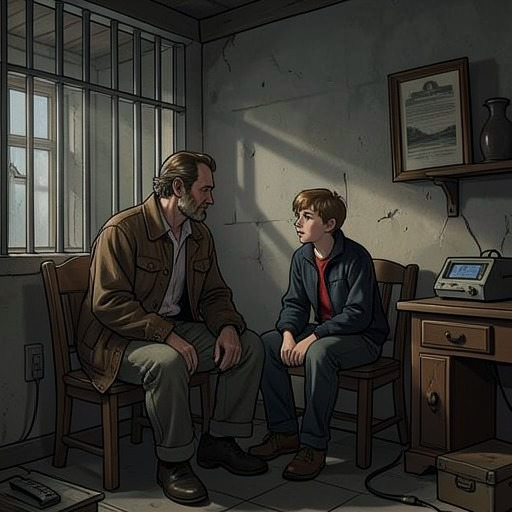
Fonny's wrongful pretrial imprisonment
If Beale Street Could TalkFonny's wrongful pretrial imprisonment turns an unresolved criminal case into a daily condition of separation and uncertainty. His confinement limits both the practical help available to him and the certainty with which others can act on his behalf. Visits matter because they connect him to people beyond the prison, while the postponement of his trial forces him to face an open-ended wait. By the time he is placed in solitary confinement after resisting an attempted rape, that waiting has become a struggle to remain alive and oriented toward a future outside the cell.
Conditions and Uncertainty
The account presents confinement as a sequence of changing arrangements rather than a single, stable prison condition. At one point, Fonny is alone in a cell at the top of the prison, but this arrangement is explicitly provisional: he is expected to be moved downstairs to a larger cell with other men. The prospect of a different cell does not offer release; it only marks another stage within detention. The narration’s attention to where he is held makes the prison’s internal geography part of his immediate reality, while the uncertainty of what comes next parallels the unresolved timing of his case.
That uncertainty is also legal. When Victoria Rogers’s disaster leads to a postponement of the trial, Fonny must absorb both the delay and its possible effect on his case. Tish tells him what has happened and why. The account does not present the news as a straightforward reversal of hope: it describes a change in how he holds hope, no longer clinging to it in the same way. The distinction matters. The postponement changes the terms of his waiting, but it does not end the imprisonment or settle the case.
Visits and the Work of Connection
The six o’clock visit gives the detention a recurring measure. Tish considers whether leaving her job would mean making that visit indefinitely; she explains the thought to Fonny, who understands her concern. Yet understanding cannot shorten the interval before the visit or remove the prison routine. A person inside still has to wait to be called, taken from the cell, and brought downstairs. The schedule makes connection dependent on an institutional process that Fonny cannot control.
The visit carries significance beyond the exchange between two people. The narration presents a constant visitor, even a single one, as evidence that someone outside continues to care. That knowledge can help a prisoner endure the night and reach the following day. Conversely, the absence of a visitor leaves a person in danger. In this account, Tish’s repeated presence therefore has a practical emotional consequence: it counters the isolation imposed by detention. Her thought that she may be making the visit forever also reveals the cost of sustaining that connection. Fonny’s imprisonment organizes her time as well as his, without making their circumstances equal.
The Fragility of Help and Testimony
Fonny’s case is entangled with the uncertain possibility of Daniel Carty’s assistance. Hayward manages to see Daniel after Daniel has been beaten, but cannot arrange his release because Daniel has been booked on a narcotics charge. Visiting him requires Hayward to become his lawyer. Daniel responds evasively and fearfully when Hayward suggests this course, and Hayward suspects that Daniel may have been drugged. He is unsure whether Daniel can safely or reliably be brought to the witness stand.
These obstacles do not establish what Daniel would say in court; they show why his potential testimony remains uncertain. Legal access, Daniel’s fear, and Hayward’s doubts all intervene before he can become a usable witness. The account thus connects Fonny’s prolonged detention to a broader difficulty: people who might contribute to his defense are themselves caught in legal and personal vulnerability. Help is not simply available or unavailable; it depends on steps that may be beyond the witness’s capacity and on decisions Hayward cannot make with confidence.
Solitary Confinement and a Changed Resolve
Later, Fonny is placed in solitary confinement after refusing an attempted rape. He is physically harmed, including the loss of another tooth, and his sight is put at risk. The narrative describes this experience as changing him permanently: his capacity for tears seems to harden, and his immediate situation becomes a fight for his life. This is not presented as a release from despair through an easy recovery. Rather, the account marks a change in his relation to despair and to the future.
The future he holds before himself is concrete: he sees his baby’s face and regards the child’s arrival as an appointment he must keep. The pregnancy gives his determination a specific point beyond prison time, even though it does not alter his confinement. He resolves to remain alive until the baby arrives, imagining that future while still held in the cell. The ending therefore binds endurance to an obligation of love, without suggesting that love makes the conditions of imprisonment harmless or brings the legal uncertainty to a close.